
If you have a tooth that is cracked, severely decayed, or weakened after a root canal, your dentist may recommend a dental crown. Crowns are one of the most common restorative procedures in dentistry, and for good reason. They protect damaged teeth, restore normal chewing function, and look natural enough that most people will never notice you have one.
This guide covers everything you need to know before your appointment: what dental crowns are, when you need one, the types available, what the procedure involves, how much they cost, and how to care for your crown once it is placed. Whether you are a patient near Brookside, Waldo, or Armour Hills searching for answers before your first consultation, or a longtime resident of the greater South Kansas City area comparing your options, this page will help you make a confident, informed decision.
What Is a Dental Crown?
A dental crown is a custom-made cap that fits over the entire visible portion of a tooth, from the gum line up. It restores the tooth’s original shape, size, strength, and appearance. Crowns are designed and shaded to blend with the surrounding teeth so the restoration looks completely natural.
Dentists refer to crowns as a “full coverage” restoration because, unlike a filling that repairs only a portion of the tooth surface, a crown encases the tooth entirely. This full coverage approach is what makes crowns so effective at protecting teeth that have been significantly compromised.
What Does a Dental Crown Look Like?
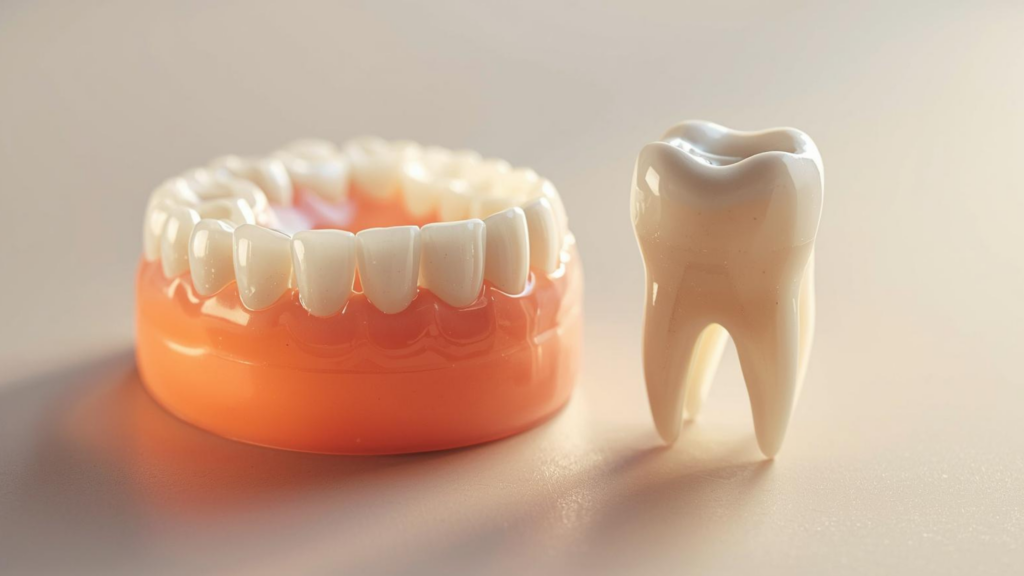
A crown looks exactly like a natural tooth. It is tooth-shaped, contoured to match the height and width of the original tooth, and color-matched to blend with adjacent teeth. When fabricated correctly, a crown is essentially invisible to anyone who is not actively looking for it.
What Does a Dental Crown Do?
Beyond aesthetics, a crown serves several functional purposes. It protects a weakened tooth from fracturing under normal biting pressure, restores a broken tooth to full form, and improves chewing efficiency when a back molar has been damaged. Crowns also prevent bacteria from re-entering a tooth after a root canal, acting as a long-term seal over the treated root system.

When Do You Need a Dental Crown?
Dentists recommend crowns when a tooth is damaged beyond what a filling or other conservative treatment can reliably restore. The decision is based on how much healthy tooth structure remains and how much daily stress the tooth must handle.
Common Reasons for Getting a Crown
- A tooth weakened by severe or recurrent decay
- A cracked or fractured tooth that is at risk of splitting
- Following a root canal, to protect the hollowed tooth structure
- Supporting a tooth that has a large existing filling with minimal healthy tooth left around it
- Restoring a tooth that has worn down from grinding or acid erosion
- Covering a dental implant abutment
- Cosmetic improvement for a severely discolored or misshapen tooth
If you have been told you grind your teeth at night and you live near Swope Park or the Blue River Greenway where outdoor activity is high and stress recovery is part of life, it is worth asking your dentist whether any of your back molars are already showing early signs of wear that could benefit from crown protection before a fracture occurs.
Types of Dental Crowns
Crown materials have advanced considerably over the past decade. The right choice depends on the location of the tooth, how much biting force it must withstand, and your cosmetic priorities.
All-Porcelain Crowns
All-porcelain crowns offer the most lifelike appearance of any crown material. They are translucent in the same way natural enamel is, making them the preferred choice for front teeth that are visible when you smile or speak. The trade-off is that all-porcelain is slightly more susceptible to chipping under heavy biting force compared to other materials.
Zirconia Crowns
Zirconia has become the dominant material in modern restorative dentistry for good reason. It is exceptionally strong, resistant to chips and cracks, and now available in tooth-colored shades that rival porcelain for aesthetics. Zirconia crowns are appropriate for both front and back teeth, making them one of the most versatile options available.
Porcelain-Fused-to-Metal (PFM) Crowns
PFM crowns have a metal substructure for strength with a porcelain outer layer for appearance. They have been a reliable standard in dentistry for decades and remain a solid option for many patients. One known limitation is that the metal margin can occasionally show at the gum line as a thin dark line, particularly as gums recede over time.
Metal Crowns
Made from gold or high-strength metal alloys, metal crowns are exceptionally durable and require the least removal of natural tooth structure. They do not match tooth color, so they are typically used on second molars that are not visible during normal conversation or smiling.
Same-Day Dental Crowns
Using CAD/CAM digital scanning technology, some dental offices can design and mill a crown in a single appointment. This eliminates the temporary crown phase and the second visit. For patients with busy schedules, same-day crowns offer a meaningful convenience without sacrificing quality.
Dental Crown Procedure: Step by Step
The crown process is straightforward and predictable. Most patients describe it as far more comfortable than they expected.
Step 1: Examination and Tooth Preparation
Your dentist will first examine the tooth with X-rays to assess the roots and surrounding bone. Once treatment is confirmed, local anesthesia is administered and the tooth is reshaped. Reshaping involves removing a thin layer from the outer surfaces so the crown has room to seat properly without making the tooth feel oversized. Any decay or damaged structure is removed at this stage.
Step 2: Impressions or Digital Scanning
After shaping, your dentist takes either a traditional impression with dental putty or a digital scan using an intraoral camera. This record is used to fabricate a crown that fits your tooth precisely. Traditional impressions are sent to an off-site dental lab. Digital scans can be sent electronically or used on-site for same-day fabrication.
Step 3: Temporary Crown Placement
If your crown is being made at a lab, you will wear a temporary crown for one to two weeks while the permanent restoration is created. Temporaries are made from acrylic and are not as strong as permanent crowns, so your dentist will advise you to avoid sticky or very hard foods during this period.
Step 4: Permanent Crown Placement
At your second appointment, the temporary is removed, the tooth is cleaned, and the permanent crown is tried in for fit, bite, and color. Once everything checks out, the crown is cemented into place with dental adhesive. Most patients leave the office the same day with a fully functional, fully restored tooth.
How Much Does a Dental Crown Cost?
Cost is one of the most common questions patients ask before committing to crown treatment, and it is a fair one.
Average Cost of Dental Crowns
The cost of a dental crown depends on the material and the complexity of the case. Zirconia and all-porcelain crowns generally fall at the higher end of that range. Metal crowns tend to be more affordable.
Factors That Affect the Cost
Several variables influence your final cost:
- Crown material (zirconia vs. metal vs. porcelain)
- Which tooth is being crowned (front teeth require more cosmetic precision)
- Whether additional treatment such as a root canal or buildup is required first
- Your dentist’s training and experience level
- Your geographic location and office overhead
- Whether your dental insurance covers crowns and what percentage it pays
At Southtown Family Dental, we accept Medicaid for patients of all ages, which is a meaningful distinction in South Kansas City. Many private practices in the Mission Hills and Prairie Village corridors do not accept Medicaid, leaving families without a reliable restorative care option. Dr. Campos built his practice specifically to remove that barrier. Your Kansas City dentist can provide a precise estimate after a clinical examination.
How Long Do Dental Crowns Last?
Average Lifespan
Most crowns last between 10 and 15 years with normal use and care. Many patients, particularly those who attend regular checkups and avoid damaging habits, get 20 or more years from a well-placed crown.
What Affects Crown Longevity
- Crown material and quality of fabrication
- Teeth grinding or clenching (bruxism), which accelerates wear significantly
- Eating hard foods like ice, hard candy, or whole nuts regularly
- Oral hygiene habits, particularly flossing around the crown margin
- Consistency with dental checkups, where early wear can be identified before it becomes a problem
How to Care for a Dental Crown
A crown is a restoration, not an indestructible replacement. The tooth underneath the crown can still develop decay at the margin if oral hygiene is neglected, so daily care matters.
Daily care habits that protect your crown:
- Brush at least twice daily with fluoride toothpaste
- Floss carefully around the crown each day, working the floss gently at the gum line rather than snapping it
- Use a soft-bristled toothbrush to avoid wearing down the crown surface or irritating surrounding gums
- Attend your regular dental checkups so your dentist can monitor the crown margin and surrounding bone
Foods that are hard on crowns:
- Ice chewing is one of the single most damaging habits for any restoration
- Hard candies and toffee
- Very hard nuts like unshelled almonds or hard pretzels
- Sticky caramel or chewy candies that can pull at the crown margin
Signs a Crown May Need Attention
Pain or sensitivity when biting, a crown that feels loose or shifted, visible chips, or gum irritation that does not resolve are all signs worth calling your dentist about. These issues are usually straightforward to address when caught early.
Dental Crown vs Other Treatment Options
Understanding where crowns fit relative to other restorations helps you have a more informed conversation with your dentist.
Crowns vs. fillings: Fillings are the right choice when decay is limited and a significant amount of healthy tooth structure remains. When decay is extensive or a tooth has already fractured, a filling cannot provide enough structural support. That is when a crown becomes the appropriate treatment.
Crowns vs. veneers: Veneers are thin porcelain shells bonded to the front surface of teeth. They are a cosmetic solution for teeth that are healthy but discolored, chipped, or slightly misaligned. Crowns cover the entire tooth and are used when the tooth itself needs structural restoration, not just cosmetic enhancement.
Crowns vs. onlays: An onlay, sometimes called a partial crown, covers one or more cusps of the tooth but not the full circumference. Onlays are appropriate for moderate damage. When damage is more extensive and full coverage is needed to prevent fracture, a crown provides superior protection.
Frequently Asked Questions
Are Dental Crowns Painful?
The procedure itself is not painful. Local anesthesia is used throughout tooth preparation and placement. Some patients experience mild sensitivity or soreness in the surrounding gum tissue for a few days after the appointment, but this resolves on its own.
How Long Does It Take to Get a Crown?
A traditional crown requires two appointments typically one to two weeks apart. Same-day crowns, when available, are completed in a single visit of roughly two to three hours.
Can a Dental Crown Fall Off?
It is uncommon, but crowns can loosen if the cement breaks down over time, if the underlying tooth develops new decay at the margin, or if a trauma or hard bite dislodges it. If your crown comes off, keep it and call your dentist promptly. Do not leave the prepared tooth unprotected for more than a day or two.
Is a Dental Crown the Same as a Dental Cap?
Yes. “Dental cap” is an older, informal term for the same restoration. You may hear both terms used interchangeably by patients and even some clinicians.
When to See a Dentist About a Dental Crown
You should schedule a consultation if you have a tooth that feels sensitive or painful when biting, a visible crack in a tooth, a large old filling that seems to be shifting or breaking down, or a tooth that has recently had a root canal and has not yet been crowned. A dentist can examine the tooth, take X-rays if needed, and let you know whether a crown is the right solution or whether a more conservative approach will work.
Schedule Your Dental Crown Consultation
Dental crowns are one of the most reliable and versatile tools in restorative dentistry. They protect damaged teeth, restore function, and look natural enough that you will quickly forget which tooth was ever treated. With proper care and regular checkups, a well-placed crown can serve you for 15 to 20 years or longer.
For patients in Waldo, Brookside, Armour Hills, and the surrounding South Kansas City neighborhoods, including those near Loose Park and Arbor Villa Park, Southtown Family Dental offers crown treatment in a practice that was built around accessibility and genuine community care. Dr. Campos is Vice President of the Greater Kansas City Dental Society and brings the kind of clinical depth and policy-level engagement that directly benefits every patient he treats. Whether you have Medicaid coverage, private insurance, or are navigating dental care costs on your own, our team will work with you to understand your options.
If you think you may need a dental crown, contact Southtown Family Dental to schedule a consultation. Getting the right information from a dentist in Kansas City that you can trust is always the best first step.

